
A sticker is not an ad. It's a piece of media that someone else chooses to display, on a surface you don't control, for as long as they feel like it.
That single fact explains why some sticker campaigns work and most don't. The campaigns that work decided where the sticker would end up before they ordered it. The ones that fail printed a logo on a die cut, put it in every box, and hoped.
This guide treats sticker marketing as a placement strategy: which surfaces you're trying to occupy, what that placement is worth, how to design for it, and how to measure something that happens entirely off your own channels.

Before choosing a tactic, decide which job you're hiring the sticker to do. Mixing them produces campaigns that do none of them well.
| Job | What it actually achieves | Right format |
|---|---|---|
| Reach | Puts your name on a surface strangers see — laptops, water bottles, toolboxes, shop doors | Small die cut, durable, one clear mark |
| Retention | Keeps an existing customer connected after purchase; adds a reason to keep the packaging | Insert card, sheet, or a pack of several designs |
| Proof | Signals belonging — "I support this," "I was there," "I'm part of this" | Event-specific, limited, dated, or numbered |
The mistake is ordering one sticker and expecting it to do all three. A reach sticker needs durability and a legible mark at 2 inches. A retention sticker needs to feel like a gift. A proof sticker needs scarcity. These pull in different directions.
In paid advertising, you pay for impressions. In sticker marketing, you're paying for a surface — and the value of that surface depends entirely on who looks at it.
Rank surfaces by attention density, not by how easy they are to distribute:
| Surface | Who sees it | Realistic value |
|---|---|---|
| Laptop lid | Cafe, coworking, classroom, transit — seen repeatedly by the same small audience plus passers-by | High frequency, narrow reach; best for design-led brands |
| Water bottle / flask | Gym, office desk, hiking — highly visible, long dwell | High dwell time; needs genuine waterproofing |
| Vehicle rear window | Thousands of drivers, low dwell, low recall | Broad but shallow; works for local businesses |
| Shop counter / till point | Captive queue audience, repeated daily | Excellent for local retail; drives add-on sales |
| Toolbox / equipment case | Trade audiences, high peer credibility | Niche but extremely high trust |
| Packaging interior | One person, one moment, high attention | Best retention surface; drives unboxing content |
The strategic question isn't "how many stickers can we afford?" It's "which of these surfaces does our customer actually occupy?" A B2B industrial brand gets more from toolboxes than laptops. A stationery brand gets more from planners than rear windows.
Durability matters here — a sticker that peels in a week wasted the placement entirely. Material selection by environment → and waterproof vs vinyl →
Planning a sticker campaign and unsure which format fits? Tell us the surface and the audience — we'll recommend the material and format that survives it. Get a campaign format recommendation →
Each of these has a defined mechanic — a reason the sticker moves, rather than an assumption that people like free things.
Mechanic: include a sticker in the package with a card inviting a review; the sticker is the reward, not the ask. Customers who photograph the sticker often leave a review in the same session.
Why it works: the sticker gives a low-effort reason to engage at the exact moment satisfaction peaks — immediately after opening.
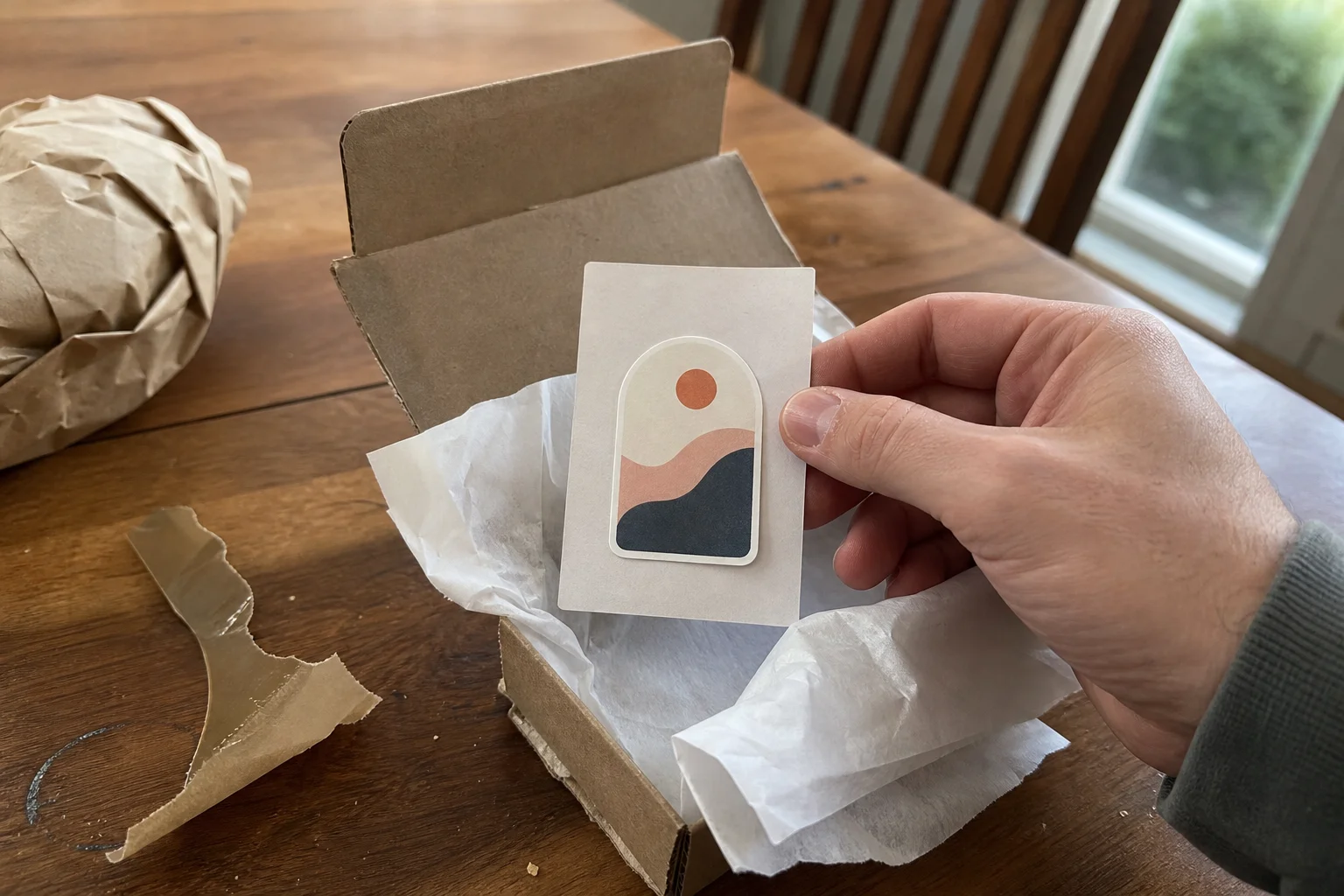
Mechanic: a small sheet rather than a single sticker, placed on top of the tissue so it's the first thing seen.
Why it works: sheets photograph better than single stickers because they show a range. Unboxing content rewards visual variety. Packaging context: Packaging and display ideas →
Mechanic: supply sticker stacks to a venue your customer already frequents — a coffee shop, a climbing gym, a record store, a co-working space. The venue gets free giveaway material; you get placement in a high-dwell environment.
Why it works: you're borrowing an audience instead of buying one, and the venue's endorsement transfers credibility.
Mechanic: six to twelve designs released in series, with one design included per order. Completion requires repeat purchase.
Why it works: it converts a one-off purchase into a reason to return. Works best where the product is consumable and repurchase is natural.
Caution: it only works if the designs are genuinely desirable as a set. Weak art makes this feel like a gimmick.
Mechanic: send existing customers a small pack and ask them to give the extras away. The pack is the referral mechanism.
Why it works: handing someone a physical object to pass on is a concrete ask, unlike "tell your friends."
Mechanic: a dated or event-specific sticker, available only at the event. Scarcity is the entire value.
Why it works: it creates proof-of-attendance, which is the strongest social currency a sticker can carry. Never reprint it — reprinting destroys the mechanic.
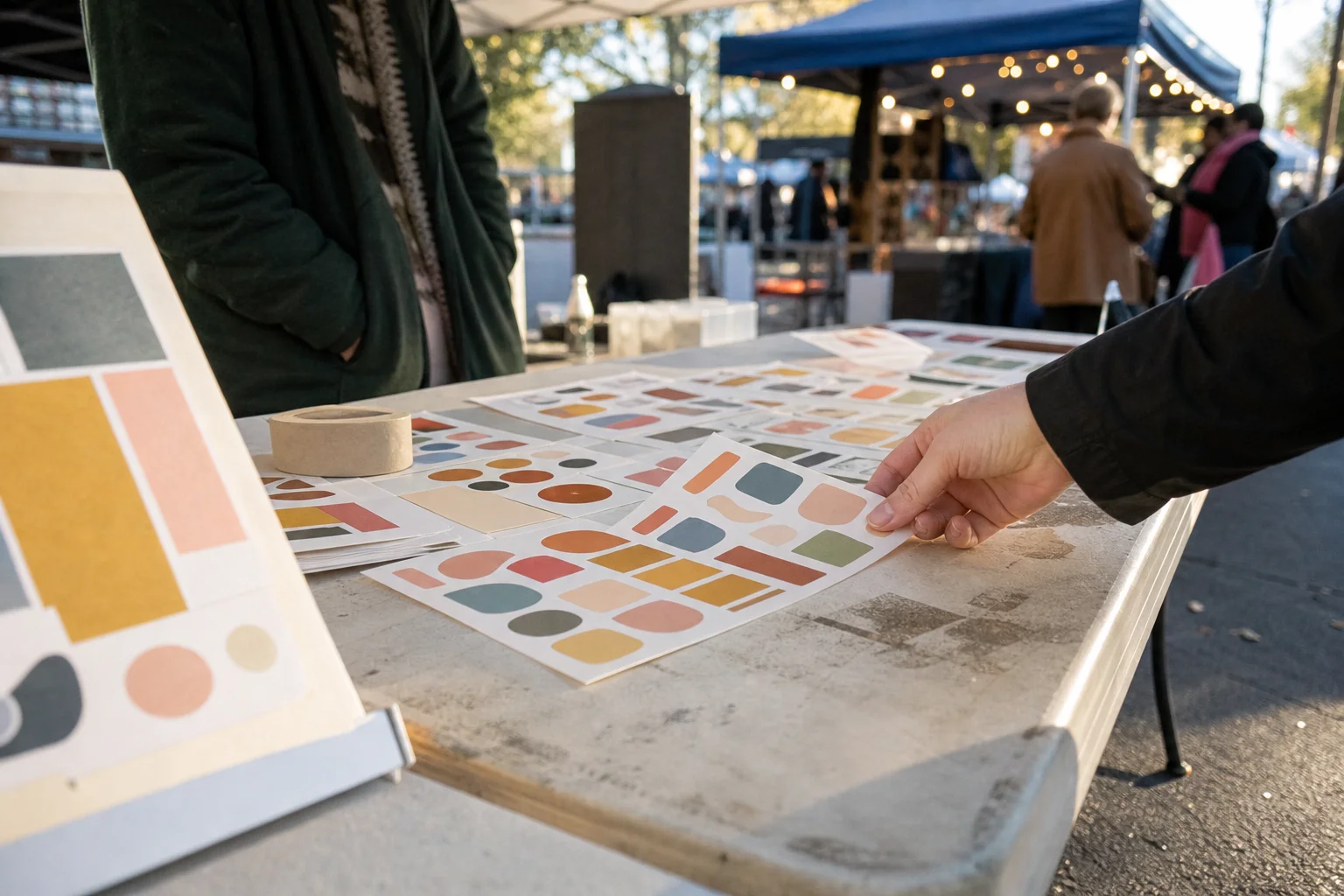
A sticker design that wins on a screen often fails on a laptop lid. Six rules that follow from the placement:
Print preparation: 10 rules for print-ready files →
Sticker marketing has a measurement problem: the impression happens on someone else's property. You cannot track it the way you track a click. What you can do is build attributable signals into the campaign.
| Signal | How to capture it | What it actually tells you |
|---|---|---|
| QR code | Unique code per campaign, on the insert card rather than the sticker | Scan rate per channel — the closest thing to an impression proxy |
| Dedicated landing page | One URL per placement partner | Which venues actually drive behaviour |
| UGC volume | Branded hashtag plus a saved-search monitor | Organic reach; also your best creative feedback |
| Redemption of a stated offer | "Show the sticker for X" at point of sale | Real-world conversion, not just exposure |
| Repeat purchase rate | Compare cohort receiving a sticker against a control group | Whether retention plays moved the number |
| Direct traffic spikes | Compare against campaign dates and event dates | Weak signal on its own — useful only as corroboration |
Be honest about the limits. Most sticker placements will never be precisely attributable. The practical approach is to run one measurable mechanism per campaign — a QR, a code, a dedicated URL — and treat everything else as brand building. Campaigns that try to track everything end up tracking nothing.
Need a campaign quantity priced before you commit? Send us your format, size, and quantity — we'll quote it with packaging inserts and split shipping if you're distributing to venues. Quote a sticker campaign →
What a realistic campaign looks like at three spending levels. Figures are structural guidance, not quotes — actual pricing depends on size, material, and quantity.
| Tier | What you can realistically run | Best job |
|---|---|---|
| Entry | One design, one size, small run; insert into existing packaging; one QR mechanism | Retention on an existing customer base |
| Mid | Three to five designs, two sizes, venue partnerships, dedicated landing pages per partner | Reach plus measurable local acquisition |
| Programme | Series releases, event-specific editions, referral kits, packaging redesign around the sticker | Building the sticker into the product experience |
Pricing mechanics so you can budget properly: Estimating sticker costs → and retail pricing →
It works when the placement is deliberate. Stickers are effective at reach in high-dwell environments, at retention inside packaging, and at proof for events. They underperform when distributed without a decision about which surface they're meant to occupy.
Order to a specific mechanism rather than a round number: enough for a defined insertion period, a defined number of venue partners, or a defined event. Track one QR code or dedicated URL per mechanism so the quantity produces a readable result rather than an unmeasurable pile.
Roughly 2 to 3 inches suits most placements — legible from a couple of feet while fitting a laptop lid, bottle, or phone case. Larger sizes suit vehicle windows and shop doors; smaller sizes work for collectible sets and event markers.
Build attribution into the campaign: a unique QR code per channel, a dedicated landing page per venue partner, or a stated offer redeemed by showing the sticker. Compare a customer cohort that received a sticker against a control group for repeat purchase rate.
Usually not. A QR on the sticker competes with the design and looks transactional. Put the QR on the insert card or the packaging, and keep the sticker itself clean — it's the object people choose to display.
Reach stickers are designed to survive on a public surface and stay legible at small size — durable material, strong silhouette. Retention stickers are designed to feel like a gift inside packaging — often a sheet or multi-design pack, where the value is the gesture rather than durability.
Long enough to produce a readable signal — typically one full purchase cycle or one event season. Shorter runs rarely generate enough data to judge, and stickers keep working after the campaign ends because they stay on the surface.
Sticker marketing is placement marketing. Choose the surface your customer already occupies, design for that surface at its real size, give the sticker a reason to stay, and build one measurable mechanism into the campaign.
Do that and the sticker keeps working long after the campaign budget is spent — which is the only real advantage it has over paid media.
Jokeystickers has produced custom stickers and sticker packs for 24 years for retail, subscription, food and beverage, and brand accounts. Free physical samples, campaign quantity pricing, and international certifications (ISO, FSC, UL, and more).
Free samples · Multi-format campaign pricing · Insert cards and packaging options
Tell us the surface, the audience, and the quantity — we'll recommend the format and quote it.
Request a Campaign Quote →Explore related products:


