
A kiss cut is a blade that cuts through the vinyl and the adhesive but stops before it reaches the backing paper. The sticker separates; the sheet does not.
That "stops on purpose" detail is the whole technology. It's also the single most common point of failure in a sticker order — because the correct depth depends on the specific combination of vinyl thickness, adhesive, and liner, and a supplier running the wrong pressure produces either stickers that tear or sheets that fall apart.
This guide is about the cut itself: how it works, what the backing paper does, how to specify it on a purchase order, and when kiss cut is the wrong tool for the job.
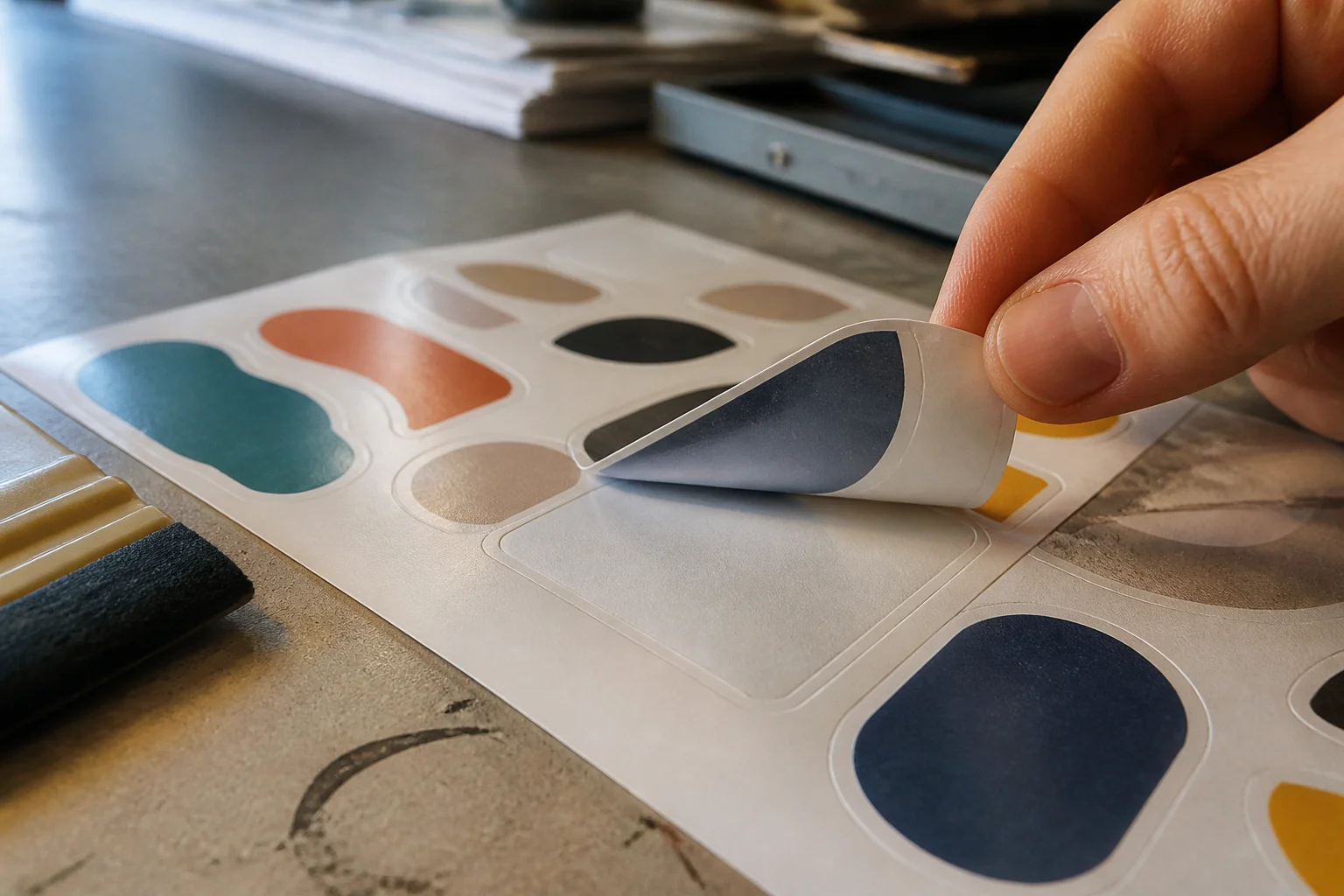
Kiss cutting is a controlled-depth operation. The blade — usually a steel rule die or a rotary die — is set to penetrate the face stock and adhesive, then stop within the liner.
Four variables determine whether it works:
This is why "kiss cut" is a specification, not a guarantee. Two suppliers can both say "kiss cut" and deliver very different peel performance.
Most comparisons explain this in terms of "peel off the sheet vs peel off the backing." That's the user experience. Here's what differs on the press:
| Factor | Kiss cut | Die cut |
|---|---|---|
| Blade depth | Through face stock and adhesive, stops in liner | Through face stock, adhesive, and liner |
| What ships | A whole sheet or roll; stickers stay on it | Individual stickers, usually on a roll or pre-stripped |
| Matrix (waste vinyl) | Not removed — stays on the sheet | Removed and discarded or rewound |
| Application method | Almost always by hand | Hand or automatic applicator |
| Relative cost | Lower — no stripping step, no matrix waste handling | Higher — extra stripping labour and material waste |
| Failure mode | Cut too shallow (tears) or too deep (sheet splits) | Cut misregistration; liner handling issues on rolls |
| Best for | Sheets, multi-up labels, hand application at volume | Single stickers, machine application, product seals |
Note the waste difference. On a kiss cut sheet, the vinyl between stickers stays in place — you're paying for that material. On a die cut roll, the matrix is stripped away. That's part of why per-sticker cost comparisons between formats can mislead. Format-level decision: Kiss cut vs die cut vs sticker sheets →
Getting inconsistent peel on your current sheets? Send us a sample and we'll diagnose whether it's cut depth, liner hardness, or adhesive age — and quote a corrected run. Send a sample for diagnosis →
Buyers spend hours on artwork and almost no time on the liner. The liner is what makes a kiss cut product usable at scale, and there are four options that change the entire workflow:
| Liner type | How it works | Best for |
|---|---|---|
| Full sheet liner | One continuous backing; user peels each sticker individually | Retail sheets, planner kits, low-volume hand application |
| Slit / split backing | Liner is cut down the middle so it can be bent and peeled away | Labels applied by hand at volume — much faster |
| Crack-and-peel | Liner is perforated into segments that break apart as you bend it | High-volume hand labelling, small labels |
| Roll with liner | Kiss cut on a roll rather than a sheet | Dispenser or applicator use, label printers |
The practical rule: if a person will apply more than about 50 stickers in a sitting, full sheet liner becomes a bottleneck. Split or crack-and-peel backing can cut application time by half or more, because the user exposes a strip of backing instead of picking at a corner every time.
This is one of the highest-return upgrades in the whole specification — and it's rarely offered unless you ask. Most suppliers default to full sheet liner because it's simplest to produce.
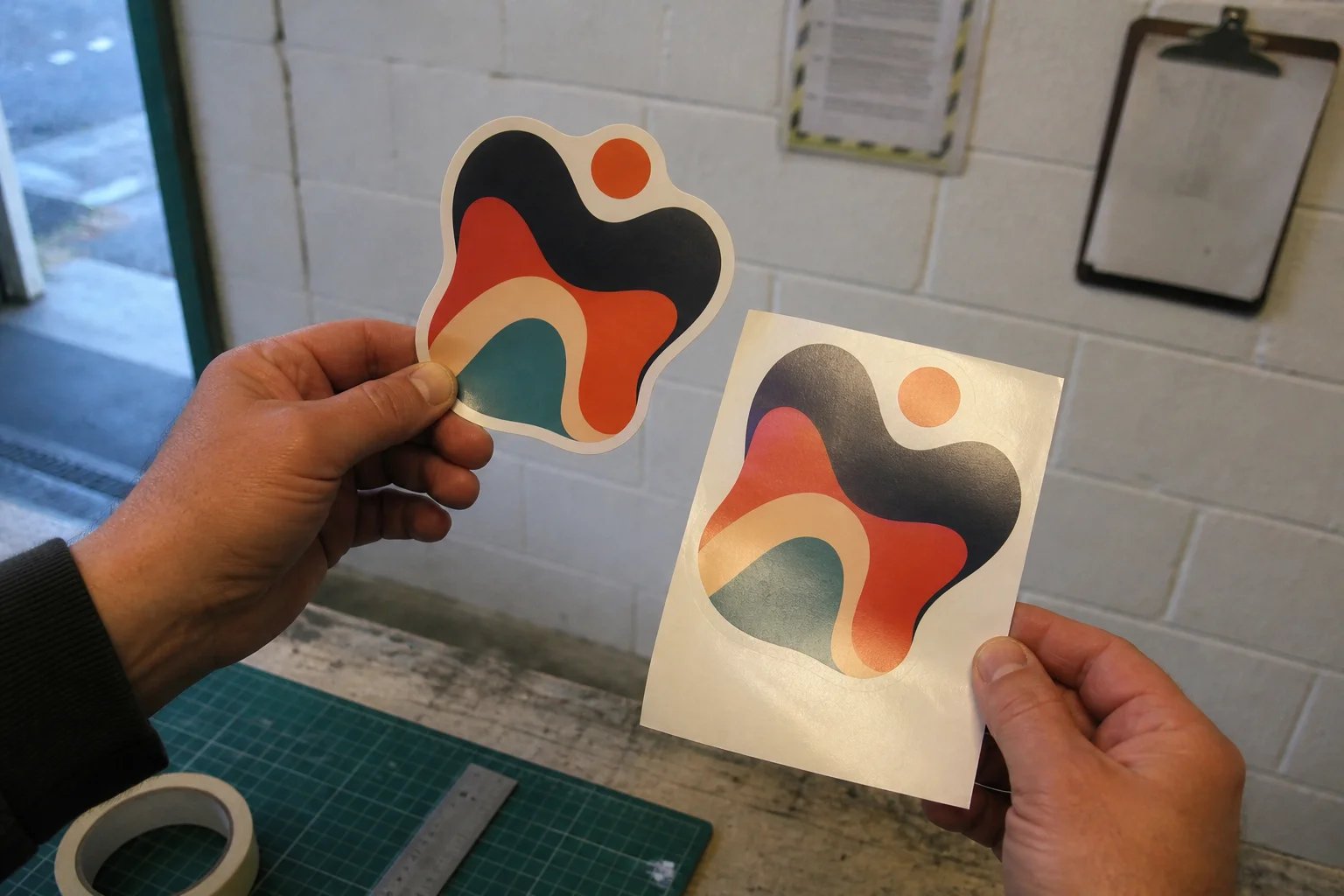
Kiss cut is the right answer whenever the product ships as a multi-unit sheet and is applied by hand:
| Application | Why kiss cut fits |
|---|---|
| Sticker sheets for retail | Many designs on one sellable unit; sheet stays intact in the bag |
| Multi-up label sheets | Address, product, and shipping labels on one sheet for hand application |
| Planner and journal stickers | The category convention — users expect a sheet, not loose stickers |
| Brand kits and press mailers | Multiple logo sizes on one sheet; recipient picks what they need |
| Coupon and insert sheets | Perforated-feel tear-off units that ship flat |
| Sample sheets for sales teams | One sheet demonstrates an entire range in a single hand-off |
Sheet-level economics and layout math are covered separately: Custom sticker sheets complete guide →
Vague specs produce variable results. These are the seven lines that should appear explicitly on any kiss cut order:
That last line is the one most buyers omit, and it's the one that gives you recourse if the run arrives wrong.
The blade scores the vinyl but doesn't fully separate it. The user peels and the sticker tears, or the edge frays. Usually caused by a dull die, insufficient pressure, or a thicker face stock than the die was set for.
The blade penetrates the liner. On a sheet, individual stickers start separating on their own; by the time it reaches the customer, pieces have shifted or fallen off. On a roll, the web can split during unwinding. Usually caused by excess pressure or a liner that's too thin for the setting.
The liner acts as the anvil. A soft liner compresses unevenly, so cut depth varies across the sheet — clean in the centre, shallow at the edges. This is a material selection error, not a press error, and it can't be fixed by pressure alone.
Some adhesives flow under heat or weight. Stored sheets can develop adhesive bleed at the cut edges, making peeling difficult months after production. Relevant for seasonal stock held in warm warehouses. Related: Adhesive and material behaviour →
Paper liners absorb moisture and expand. In humid storage, sheets can cockle, which changes how the cut edge releases. For humid climates, a PET liner is more dimensionally stable — at a higher material cost.

Want your specs reviewed before you order? Send us your face stock, liner, and application method — we'll confirm whether the combination will actually peel the way you expect. Get a spec review →
Kiss cut is not a universal default. Choose something else when:
Format-level guidance: Which format is right for you →
A kiss cut sticker is cut through the vinyl and adhesive but not through the backing paper, so the sticker peels off individually while the surrounding sheet remains intact. The cut "kisses" the liner without penetrating it.
Die cutting goes through the vinyl, adhesive, and backing, producing individual stickers free of the sheet, with waste vinyl removed. Kiss cutting stops at the backing, keeping the sheet whole and leaving the surrounding vinyl in place. Kiss cut is typically cheaper because it skips the waste-stripping step.
Usually one of three causes: the cut is too shallow and the vinyl hasn't fully separated, the adhesive has migrated to the cut edges during storage, or the liner is too soft and the cut depth varies across the sheet. A physical sample submitted to the supplier is the fastest way to diagnose which.
Split backing means the liner is cut down the middle so the sheet can be bent to expose an edge, letting the user peel the liner away in one motion instead of picking at a corner for each sticker. It dramatically speeds up hand application at volume.
Rarely. Automated applicators and label dispensers generally require individually die cut stickers on a roll, because they cannot separate a sticker from an intact sheet reliably. Kiss cut is designed for hand application.
Usually yes, because there's no matrix stripping step and no waste vinyl handling. However, the vinyl between stickers remains on a kiss cut sheet, so you are paying for that material. Compare formats on a per-sticker basis rather than per unit.
Use a full sheet liner for retail sheets and low-volume hand application. Use split or crack-and-peel backing when someone will apply more than roughly 50 stickers at a time. In humid climates, a PET liner is more dimensionally stable than paper.
State the face stock and thickness, adhesive type, liner type and thickness, that the cut must penetrate face stock and adhesive but not the liner, the separate cut-line layer, corner radius, and an acceptance test defining clean hand release without tearing.
"Kiss cut" describes an intention, not a result. The result depends on face stock, adhesive, liner hardness, die condition, and press pressure — and on whether the buyer specified any of it.
Put the seven lines on the purchase order, choose the liner based on how the sticker will actually be applied, and test a physical sample in your own storage conditions. That's the difference between a sheet that works and a sheet that generates complaints.
Jokeystickers has produced kiss cut stickers and sheets for 24 years across retail, subscription, and brand accounts. Free physical samples with the exact liner, free artwork preflight, and international certifications (ISO, FSC, UL, and more).
Free spec review · Free physical samples · Free artwork preflight
Tell us your face stock, liner, and how the stickers will be applied — we'll confirm the combination and quote it.
Request a Kiss Cut Quote →Explore related products:


