
A food label has to satisfy two separate sets of rules, and most buyers only think about the first one.
The first is what the label says — statement of identity, net quantity, ingredients, allergens, nutrition facts. This is the part governed by 21 CFR Part 101, and it's what everyone researches.
The second is what the label is made of. A label touches food packaging, and sometimes food directly. The adhesive, face stock, and ink are regulated as indirect food additives. This is the part that quietly fails audits — and the part a label supplier should be able to document.
This guide covers both, plus the material choices that determine whether your label survives a freezer, a chilled case, or an oily surface.
There is no FDA label approval step. The agency does not review and sign off your artwork before printing. Compliance is the responsibility of the firm whose name is on the product.
This matters practically. If a supplier tells you "the FDA approved this label," that statement is wrong — and it's a signal they don't understand the regulatory landscape. What a competent supplier provides is different: a label built to your supplied content, plus documentation on the materials.
The corollary is uncomfortable but important: your printer cannot make your label compliant. They can print what you send correctly and supply compliant materials. The claims, ingredient list, and allergen statement are your responsibility — normally reviewed by a regulatory consultant or counsel, not a printer.
For most packaged foods sold in the US, the principal display panel and information panel carry six required elements:
| Element | What it involves | Common failure |
|---|---|---|
| Statement of identity | The common or usual name of the food | Creative name with no descriptive term — "Sunrise Blend" without "ground coffee" |
| Net quantity of contents | Weight, volume, or count, in the required units and position | Placed in a random spot rather than the lower third of the display panel |
| Ingredient list | All ingredients by common name, descending order by weight | Compound ingredients listed without breaking out sub-ingredients |
| Major allergen declaration | All nine major allergens declared by name | Missing sesame, or hiding an allergen inside a "spices" or "natural flavor" entry |
| Nutrition Facts panel | Per 21 CFR 101.9, unless an exemption applies | Using an outdated format or wrong serving size basis |
| Name and place of business | Manufacturer, packer, or distributor, with a verifiable address | PO box only, or a brand name with no responsible firm |
Formatting details — type size minimums, bold requirements, contrast, and placement — are specified in 21 CFR Part 101, Subpart B. Those rules are numeric and unforgiving; a label can contain every required element and still be non-compliant because the net quantity is in the wrong type size for the panel area.
Need a label printed to your regulatory artwork? Send us your approved print-ready file and we'll produce it on food-contact-compliant stock, with material documentation included. Get a food label quote →
The US major food allergen list expanded to nine. Under the FASTER Act, sesame became the ninth major food allergen, effective January 1, 2023, joining milk, eggs, fish, crustacean shellfish, tree nuts, peanuts, wheat, and soybeans.
Two practical consequences that trip up small producers:
Sesame is also the allergen most often missed by producers reformulating an existing recipe, because it enters through suppliers rather than the recipe itself — a new bun supplier, a new seasoning blend. Confirm allergen status with every ingredient supplier, in writing, at every reformulation.
FDA reference: Sesame Added as a Major Food Allergen (FDA factsheet)
Nutrition labeling under 21 CFR 101.9 applies to most packaged foods, but there are exemptions — and the small business provisions are the ones most often misunderstood.
Section 101.9(j) contains, among others, a retail exemption tied to annual gross sales: a firm with annual gross sales to consumers of no more than $500,000, or annual gross sales in food sales to consumers of no more than $50,000, may qualify. There are also low-volume provisions and conditions attached — including that the exemption is forfeited if nutrition claims are made.
Three cautions:
Label adhesives, face stocks, and inks are regulated as indirect food additives when they may reasonably become components of food. The relevant regulations are specific:
What this means in practice depends on the contact scenario, which is why the question "is this food grade?" is close to meaningless on its own. "Food grade" is not a legally defined term in FDA regulation. What matters is the specific compliance route for the specific material in the specific contact condition.
Ask your supplier which scenario they're certifying for. A supplier who answers "all of them" without asking you a question hasn't understood the request.
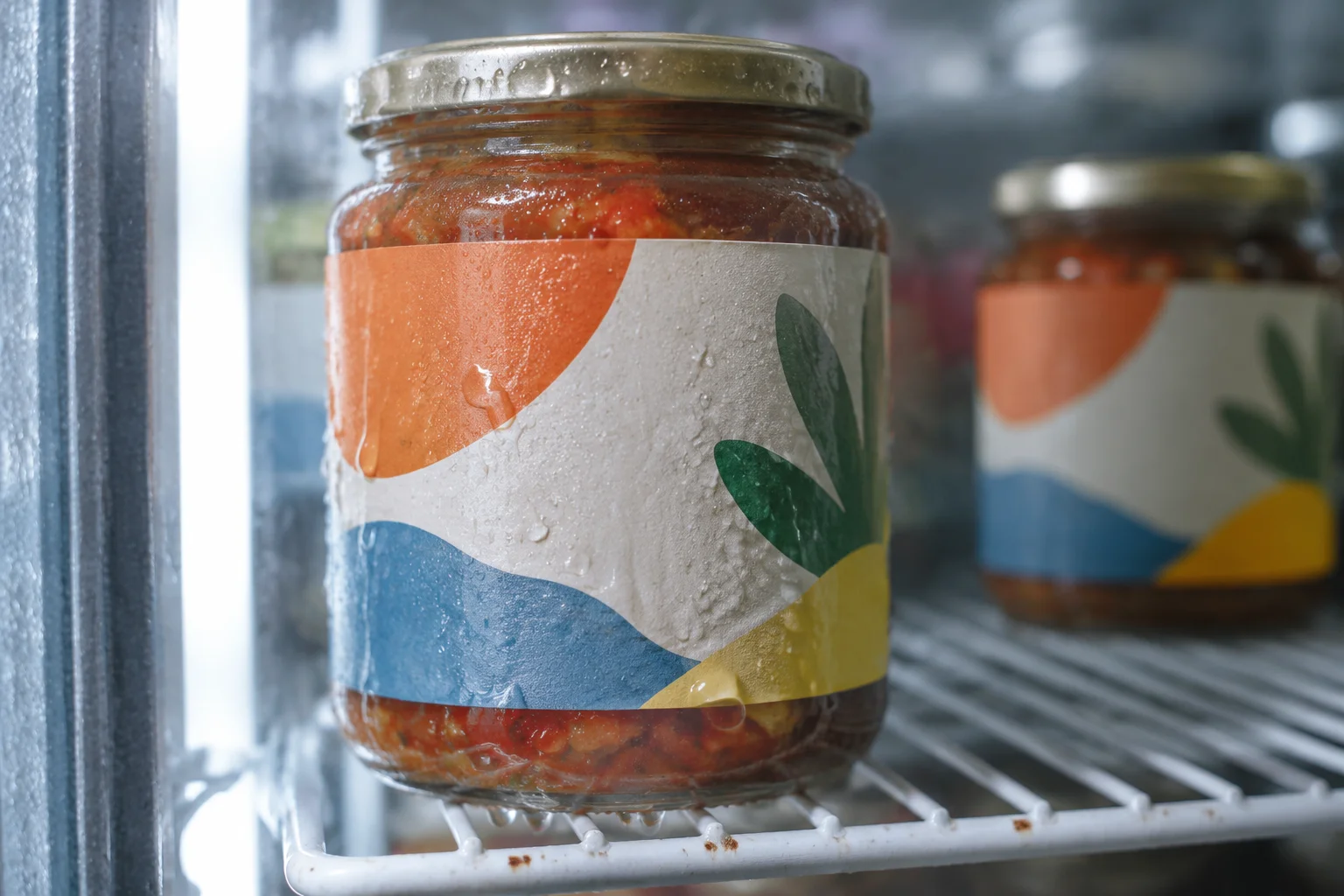
Once your artwork is compliant, the label still has to physically survive the product's environment. This is where most reprints originate:
| Application | What the label must survive | Material direction |
|---|---|---|
| Chilled / refrigerated | Condensation, repeated temperature swings, wet handling | Water-resistant face stock with a chilled-grade adhesive; test on a wet bottle, not a dry one |
| Frozen | Sub-zero adhesion, ice crystal formation, moisture on application | Freezer-grade adhesive rated below the storage temperature with margin |
| Oily / greasy foods | Oil migration under the label edge, adhesive softening | Grease-resistant face stock; verify adhesive compatibility with the specific oil |
| Hot fill / pasteurised | Elevated temperature at application, then cooling | Heat-tolerant adhesive; confirm the application temperature, not just storage |
| Dry goods | Dust, abrasion in transit, long shelf life | Standard permanent adhesive usually sufficient; focus on scuff resistance |
| Condensation-prone display | Continuous moisture on the outside of the pack | Gloss or matte synthetic laminate over a water-resistant base |
Material behaviour in depth: Sticker and label materials compared → and Waterproof vs vinyl →

Not sure which adhesive survives your cold chain? Tell us your storage temperature and surface — we'll recommend a material and send a sample to test in your own conditions. Ask for a material recommendation →
Compliance is a paper trail as much as a product. Ask for these before the first production run:
Supplier vetting in broader terms: Wholesale supplier checklist →
No. The FDA does not pre-approve labels. The firm whose name appears on the product is responsible for compliance. A supplier claiming FDA approval of your artwork is misstating the process.
Generally a statement of identity, net quantity of contents, ingredient list, major allergen declaration, Nutrition Facts panel (unless exempt), and the name and place of business of the manufacturer, packer, or distributor. Formatting rules are in 21 CFR Part 101, Subpart B.
Nine: milk, eggs, fish, crustacean shellfish, tree nuts, peanuts, wheat, soybeans, and sesame. Sesame was added as the ninth under the FASTER Act, effective January 1, 2023.
Possibly. 21 CFR 101.9(j) includes small business provisions, including a retail exemption tied to annual gross sales thresholds of $500,000 to consumers or $50,000 in food sales to consumers. Conditions apply, and making a nutrient claim generally forfeits the exemption. Confirm your specific position with FDA guidance or a regulatory professional.
"Food grade" is not a legally defined term in FDA regulation. What matters is whether the specific adhesive, face stock, and ink comply with the applicable regulation for your contact scenario — for example 21 CFR 175.105 for adhesives or 175.125 for pressure-sensitive adhesives.
Requirements depend on the contact scenario. For indirect contact through an intact package barrier, requirements are lighter than for direct contact, but documentation is still expected — particularly by retailers and co-packers conducting supplier audits.
A freezer-grade adhesive rated below your actual storage temperature with margin, on a moisture-resistant face stock. Test on a surface with frost or condensation present, since application conditions matter as much as storage conditions.
Usually an adhesive that isn't rated for chilled, wet conditions, or application to a dry label on a bottle that then condensates. Water-resistant face stock with a chilled-grade adhesive, tested on a wet bottle, resolves most cases.
Food label compliance splits cleanly in two: the content, which is your regulatory responsibility, and the material, which is your supplier's. Both need documentation, and neither is satisfied by the phrase "FDA approved."
Build the label to the required elements, declare all nine allergens, verify any nutrition exemption rather than assuming it, and specify materials against the actual contact scenario and storage conditions. Then test a sample where the product really lives.
This article is general information, not legal advice. Label compliance depends on your specific product, claims, and sales structure — confirm with FDA guidance or a qualified regulatory professional.
Jokeystickers has produced custom labels for 24 years for food, beverage, and retail accounts. Food-contact-compliant adhesive options with written documentation, freezer and chilled grades, free physical samples, and international certifications (ISO, FSC, UL, and more).
Food-contact compliant adhesives · Freezer & chilled grades · Written compliance statements
Send your artwork and storage conditions — we'll recommend the material and document it.
Request a Food Label Quote →Explore related products:


