
Search for custom stickers and you'll find hundreds of sites that all look like manufacturers. Some run presses. Some buy from someone who runs presses. Some are a form, a payment processor, and an overseas supplier they've never visited.
None of that is inherently dishonest — reselling is a legitimate business model with real advantages. The problem is that buyers can't tell the difference, and the difference determines your price, your lead time, who answers when something goes wrong, and whether you can get documentation for a compliance audit.
This guide maps the four models honestly, including where resellers genuinely win, and gives you the questions that reveal which one you're actually talking to.
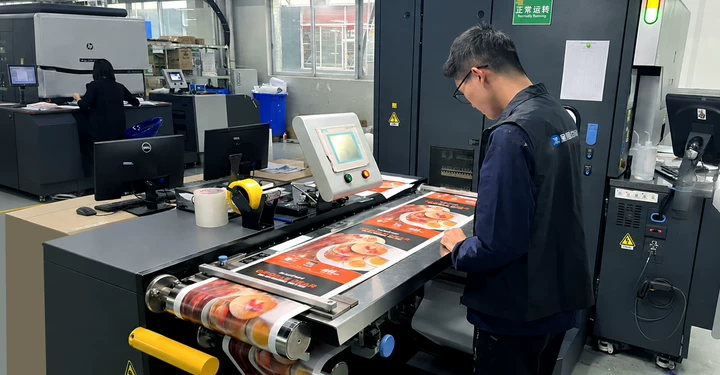
| Model | What they actually do | Where your money goes |
|---|---|---|
| Manufacturer (factory-direct) | Owns presses, cuts, laminates, and finishes in-house; sells to you directly | Materials, machine time, labour, margin |
| Converter | Buys raw material, prints and finishes, but may outsource specialised steps | Materials, conversion, subcontractor costs, margin |
| Reseller / broker | Takes your order, sends it to a factory, handles the transaction | Factory cost, plus a markup for coordination |
| Print-on-demand platform | Aggregates orders onto a large-format press; automated, no human preflight | Platform cost, press time, minimal support |
The distinctions blur in practice. A converter may describe itself as a factory. A factory may resell items it doesn't produce. A broker may be excellent and deeply knowledgeable. The label matters far less than who controls production and who holds responsibility when it fails.
Every layer between you and the press adds cost without adding production value. A simplified chain looks like this:
On simple, high-volume work, the reseller layer is where the price gap comes from. On small, complex, or service-heavy orders, that layer often earns its keep — more on that below.
How to read a quote line by line: Estimating sticker costs →
Want to know what your current supplier's quote actually contains? Send us a recent quote and we'll break down the material, cut, and finishing components so you can see what you're paying for. Get a quote breakdown →
Not everything. These five things, specifically:
When a run arrives with the cut too deep or the laminate lifting, a factory fixes it on their own equipment. A reseller has to negotiate with a third party they may have limited leverage over. The difference shows up in how fast a reprint happens, and whether it happens at all.
Cut quality failures specifically: Kiss cut depth and liner problems →
Undisclosed substitution — a thinner face stock, a cheaper liner, a different adhesive — is one of the most common quality failures in this industry. When you buy through a broker, you often can't detect it because you never see the material specification. Factory-direct means the spec is on the production order and you can ask to see it.
For regulated products, this is decisive. Food labels need material compliance statements referencing specific regulations, not a generic claim. A reseller may be able to obtain these, but the chain of custody is longer and slower. Food label material compliance →
Unusual sheet sizes, mixed finishes on one order, split-back liners, short runs of a specific construction — these require someone who can change a setup. A broker can only sell what their factory offers.
"Why are my labels lifting in the chiller?" has a material answer: adhesive grade, surface energy, application temperature, condensation. A factory can diagnose it. A reseller can only relay the question.
An honest comparison has to include this, because factory-direct is not the right answer for everyone.
| Situation | Why a reseller may be the better choice |
|---|---|
| Very small first orders | Some resellers aggregate volume across customers to hit factory minimums you couldn't reach alone |
| You need design help | Good resellers provide artwork support, which many factories don't |
| You want one invoice for many products | Consolidating stickers, packaging, and printed collateral through one vendor reduces admin |
| You need local timezone and language support | Meaningful if you don't want to manage an overseas production relationship |
| You need warehousing or kitting | Some resellers hold stock and assemble kits — a service factories rarely offer |
| You're testing a category | Low commitment while you validate demand, before negotiating factory minimums |
If you're in one of those situations, the reseller markup is paying for something real. The mistake is paying reseller prices while believing you're buying factory-direct — or paying factory minimums when a reseller's flexibility was what you actually needed.
Ask these before discussing price. The answers are hard to fake consistently:
Broader supplier diligence: 12-point supplier checklist →
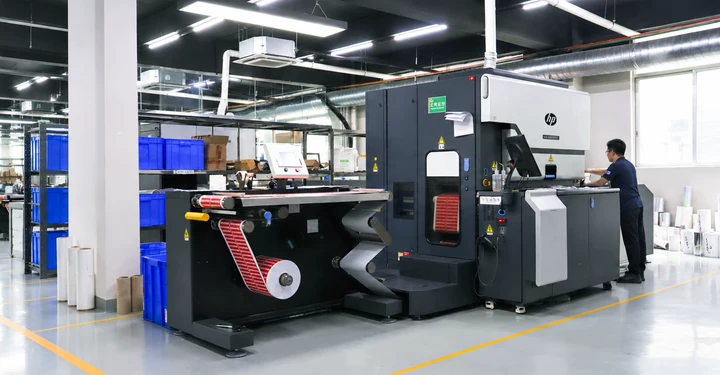
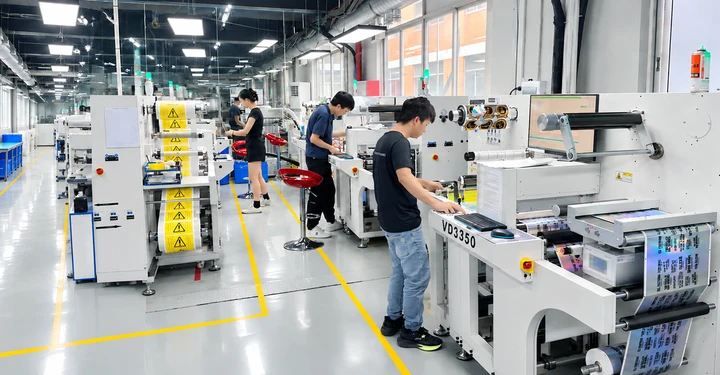
Would rather verify than take our word for it? Book a live video walkthrough of our production floor — we'll show you the presses running and answer material questions on the call. Request a factory walkthrough →
Seven checks, in order of how hard they are to fake:
| Your situation | Reasonable choice | Why |
|---|---|---|
| Validating a product idea, sub-500 units | Print-on-demand or reseller | Speed and low commitment matter more than unit cost |
| Launching a retail line, 1,000–5,000 units | Factory-direct | Unit economics and material control start to dominate |
| Regulated category (food, beverage, cosmetics) | Factory-direct with documentation | Material compliance statements and traceability |
| Multi-SKU retail programme | Factory-direct | Consistent spec across the line; volume pricing |
| Need design support and one vendor | Reseller with real capability | Services are the product you're buying |
| Recurring reorders of a proven spec | Factory-direct | Nothing is being added by the middle layer at this point |
Usually cheaper per unit at volume, because there's no reseller markup. But not always at very small quantities, where a reseller's aggregated volume may reach better pricing than you could negotiate alone. Compare total landed cost, not just unit price.
Ask for a live video walkthrough of the production floor, verify certificate numbers and that the certified entity matches your contract counterparty, ask technical questions only a production team can answer, and request a sample with a non-standard specification.
No. Resellers provide real value in design support, small-order flexibility, consolidated invoicing, local support, and kitting. The issue isn't the model — it's paying factory-direct prices while receiving reseller service, or believing a reseller markup is production cost.
That the company you're buying from owns and operates the production equipment, rather than passing your order to a third party. In practice it also means they control material specification, cut settings, and quality inspection — and are accountable when those fail.
Because the quote may reflect a full specification — a specific face stock, laminate, liner, and cut — rather than a stripped-down construction. Compare quotes line by line on material and finishing, not on headline unit price.
Often yes, but the chain is longer: the reseller must obtain statements from their supplier, who may obtain them from a material manufacturer. Ask how long documentation takes and whether it names specific regulations rather than a generic compliance claim.
Undisclosed material substitution. If you never see the material specification, you can't detect a thinner face stock or a cheaper adhesive until the product fails in use — often after it has shipped to your customers.
Factory-direct isn't a moral position; it's a structural one. It buys you control over material, cut, documentation, and accountability. Those things matter enormously at scale and in regulated categories, and matter much less when you're validating an idea with 200 units.
The failure mode isn't choosing a reseller. It's not knowing which one you chose — and paying for one while getting the other.
Jokeystickers has manufactured custom stickers and labels for 24 years as a factory-direct producer, serving retail, food and beverage, subscription, and brand accounts. International certifications (ISO, FSC, UL, and more), free physical samples, and live video walkthroughs on request.
Live floor walkthrough · Free physical samples · Material documentation
Send your spec or your current quote — we'll tell you exactly what's in it and what we'd change.
Request a Factory Quote →Explore related products:


