
Your customer never sees your production quality. She sees a bag on a counter — for about three seconds, on her way to the register.
That's the whole game with sticker pack packaging. Good packaging converts a three-second glance into a pickup. Bad packaging hides perfectly good stickers behind a generic bag and lets them sit.
This guide covers the packaging components worth specifying, and the display setups that move packs fastest in real stores.
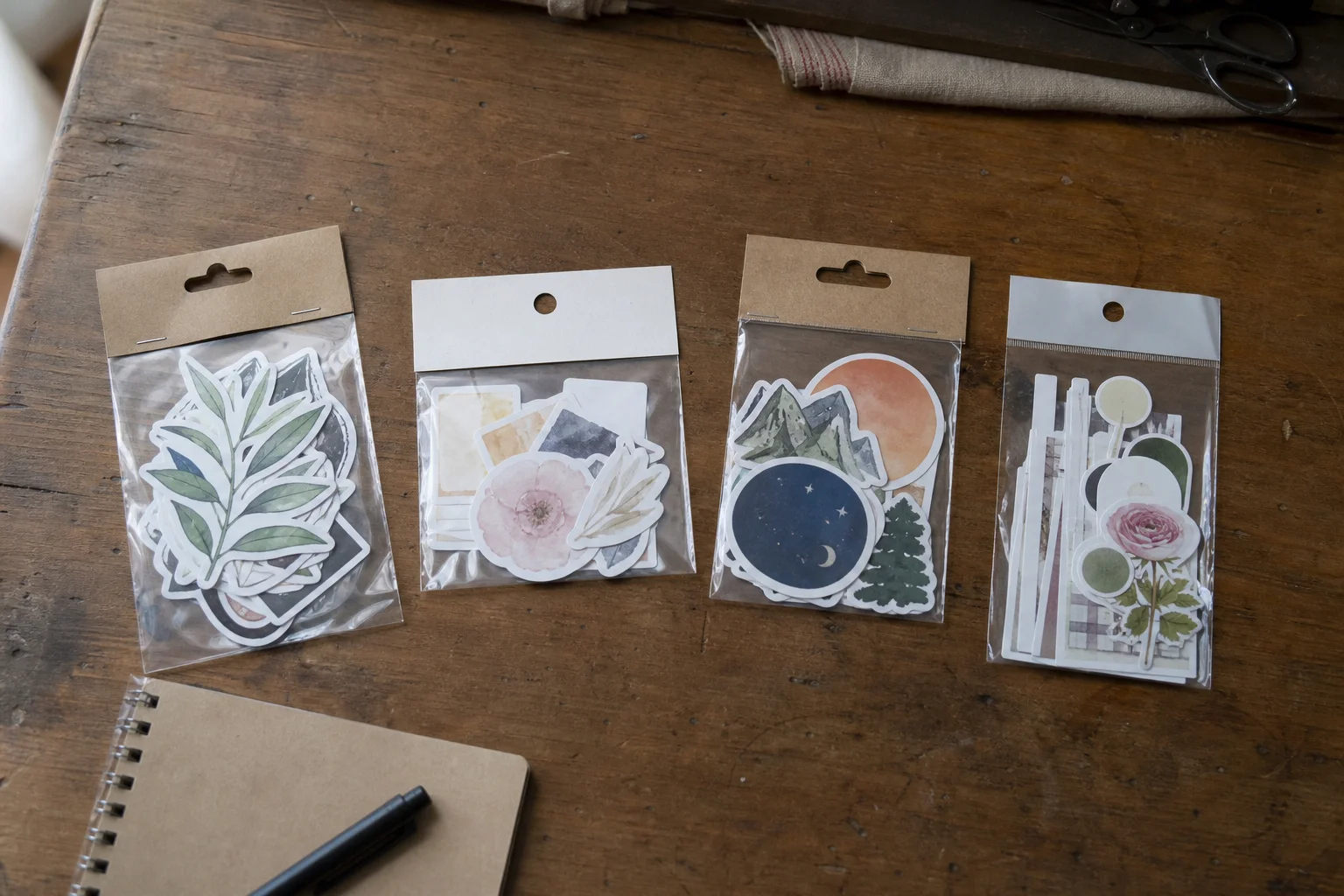
Every retail sticker pack is built from the same five parts. Specifying each one deliberately separates a pack that sells from one that doesn't:
| Component | What it does | What to watch |
|---|---|---|
| Bag / sleeve | Holds the stickers, protects them | Thickness — too thin reads cheap and creases |
| Header card | Carries theme name, brand, barcode | Paper weight — flimsy cards curl and look amateur |
| Backing / insert card | Shows the full design set at a glance | Whether it makes the count visible from outside |
| Barcode / SKU label | Scans at POS, tracks sell-through | Position — must be scannable without removing the pack |
| Seal / hang tab | Closes the pack, enables pegboard hanging | Whether you need peg display or counter display |
Clear bags dominate because they show the product — which is exactly what a 1–4 dollar impulse item needs. Rigid boxes add cost and hide the stickers, and only earn their price at the premium tier, where the unboxing itself is part of the value. For most retail lines, clear bag plus a well-printed header card is the right call.
Need packaging produced with your packs? We print header cards, insert cards, and barcode labels to match your pack spec — delivered already packaged and retail-ready. Ask about retail-ready packaging →
The header card is the single highest-leverage component. It's the only part of the pack the customer actually reads. Four decisions matter:
Customers scan for a category, not a description. A short theme name — two to three words — at the top of the card lets them sort the display instantly. Long names and taglines don't get read at counter speed.
If the bag is small or the stickers are stacked, the customer can't see what's inside. Print a small preview of the design set on the card. This converts better than almost any other packaging change because it answers "what am I actually buying" before the customer has to ask.
State the sticker count on the card. Count is the primary value signal for a pack, and buyers use it to compare packs across your display. Leaving it off is a missed sale, not a neutral choice.
When every pack in your display uses the same card layout, the display reads as a curated line rather than a pile of unrelated products. Consistency also makes it obvious when a theme is missing — which drives restock discipline.
Packaging gets the pickup. Display gets the repeat pickup, from the next customer. Four setups that work in real stores:
The default. Two to three small tiers, sitting beside the register, holding 30–60 packs. Tiering matters because it lifts packs above the counter line and into the customer's natural sightline while they wait. Flat single-layer trays get overlooked.
Best where you have wall space and want to keep the counter clear. Hang packs on a short strip at eye level — not above it. Packs hung too high lose impulse buyers, because reaching up signals a deliberate purchase decision.
For larger lines. A spinner holds several themes and lets customers browse without staff help. Works best where traffic pauses — near fitting rooms, at aisle ends, or beside the queue line.
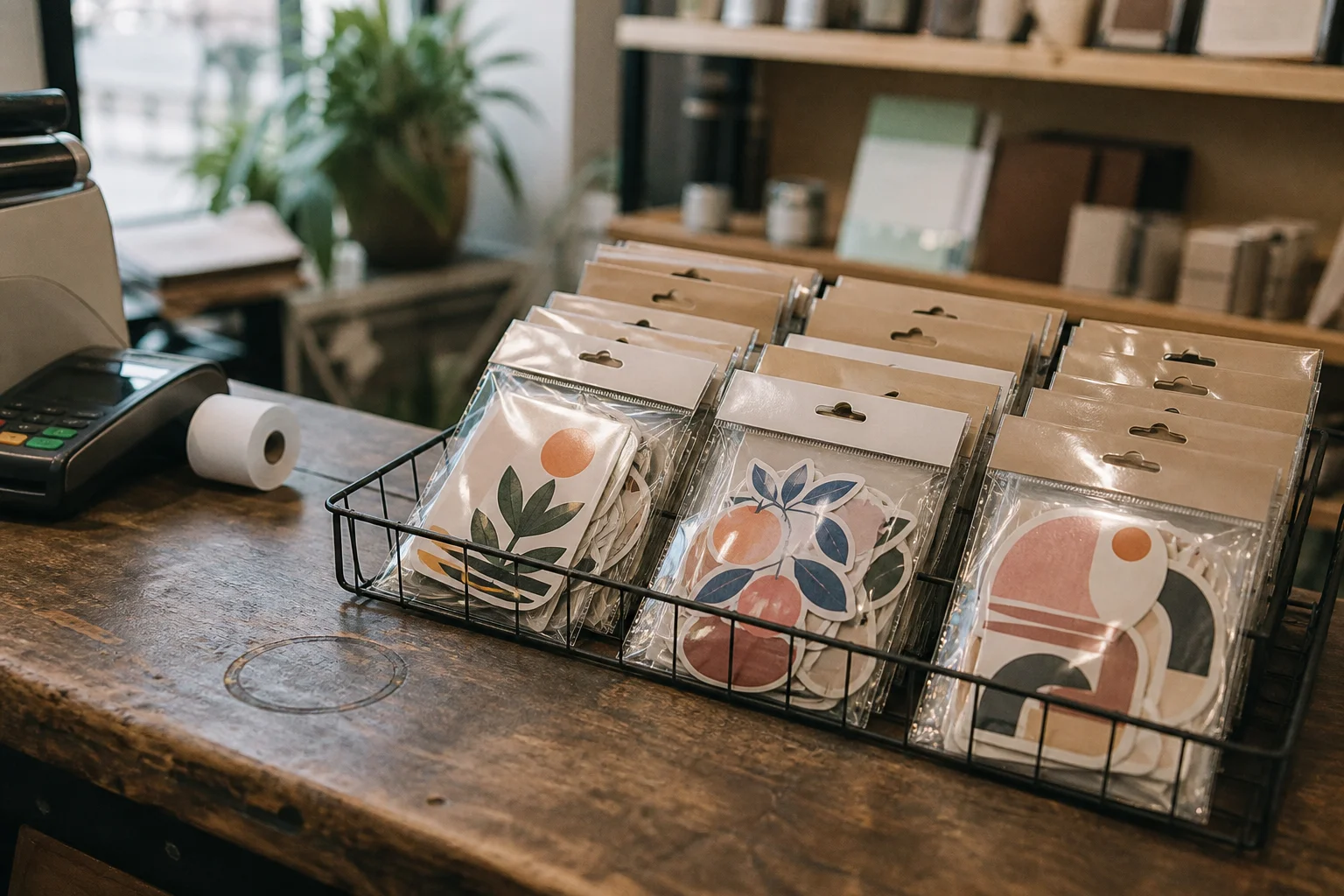
The lowest-effort option and still effective: a shallow basket of loose packs right at the payment point. Cheap to set up, easy to restock, and it captures customers who never look up from the counter.
Placement strategy in more depth: How to sell sticker packs in your store →
Want display-ready cases instead of loose packs? We can ship packs pre-loaded on header cards with barcode labels applied, so your display goes up straight out of the carton. Request a display-ready quote →

Bring this list to your supplier. It covers everything that has to be decided before production, and nothing can be added afterwards:
A clear bag with a printed header card is the standard for retail sticker packs — it protects the stickers, shows the product through the bag, and gives you a surface for theme name, count, design preview, and barcode. Rigid boxes only make sense at premium price points.
Yes, whenever the stickers inside aren't clearly visible through the bag. A design preview on the card answers "what am I buying" before the customer has to ask, and it's one of the highest-impact packaging changes a retailer can make.
If you sell through a POS system, yes. Without a barcode, every sticker pack sale requires manual entry at the register, which slows checkout and quietly reduces impulse purchases. Ask for the barcode to be printed on the header card in a position that scans without unpacking.
In the wait zone — beside the register, at the queue line, or at an aisle end where customers pause. The best-performing setups are tiered countertop stands and eye-level pegboard strips. Displays placed away from where customers stand still convert far worse.
Enough to look full without being hard to browse. A tiered countertop stand holding 30–60 packs is typical. Restock as soon as the display thins — a half-empty display underperforms a full one regardless of which themes remain.
Yes, and it's usually worth it. Suppliers can deliver packs pre-bagged, with header cards printed and barcodes applied, so the display goes up directly out of the carton without any in-store assembly. Ask about retail-ready packing →
Countertop tiered stands convert best because they sit in the customer's sightline during the wait. Pegboard works well when counter space is limited, but keep the strip at eye level — packs hung too high lose impulse buyers.
Packaging decisions are locked at production. Barcode position, hang tabs, card dimensions, design previews — none of it can be changed after the run, and all of it affects whether your packs sell.
Jokeystickers has manufactured custom stickers for 24 years — packs delivered retail-ready with printed header cards, insert cards, and barcode labels, backed by international certifications (ISO, FSC, UL, and more). Free physical samples before production.
Free samples · Header cards · Barcode labels · DDP shipping
Send your pack spec and we'll quote packaging that arrives display-ready.
Request a Packaging Quote →Explore related products:


