
You've chosen your sticker packs, picked your format mix, and set up a display. Now you have to write a number on the tag — and that number decides whether the shelf becomes your best-performing square foot or a slow-moving write-off.
Pricing sticker packs isn't complicated, but it does follow rules that aren't obvious. Too high and the impulse purchase dies. Too low and you can't restock the display with the profit you made. This guide gives you the actual math, the price points that work, and the mistakes that quietly cost retailers money.
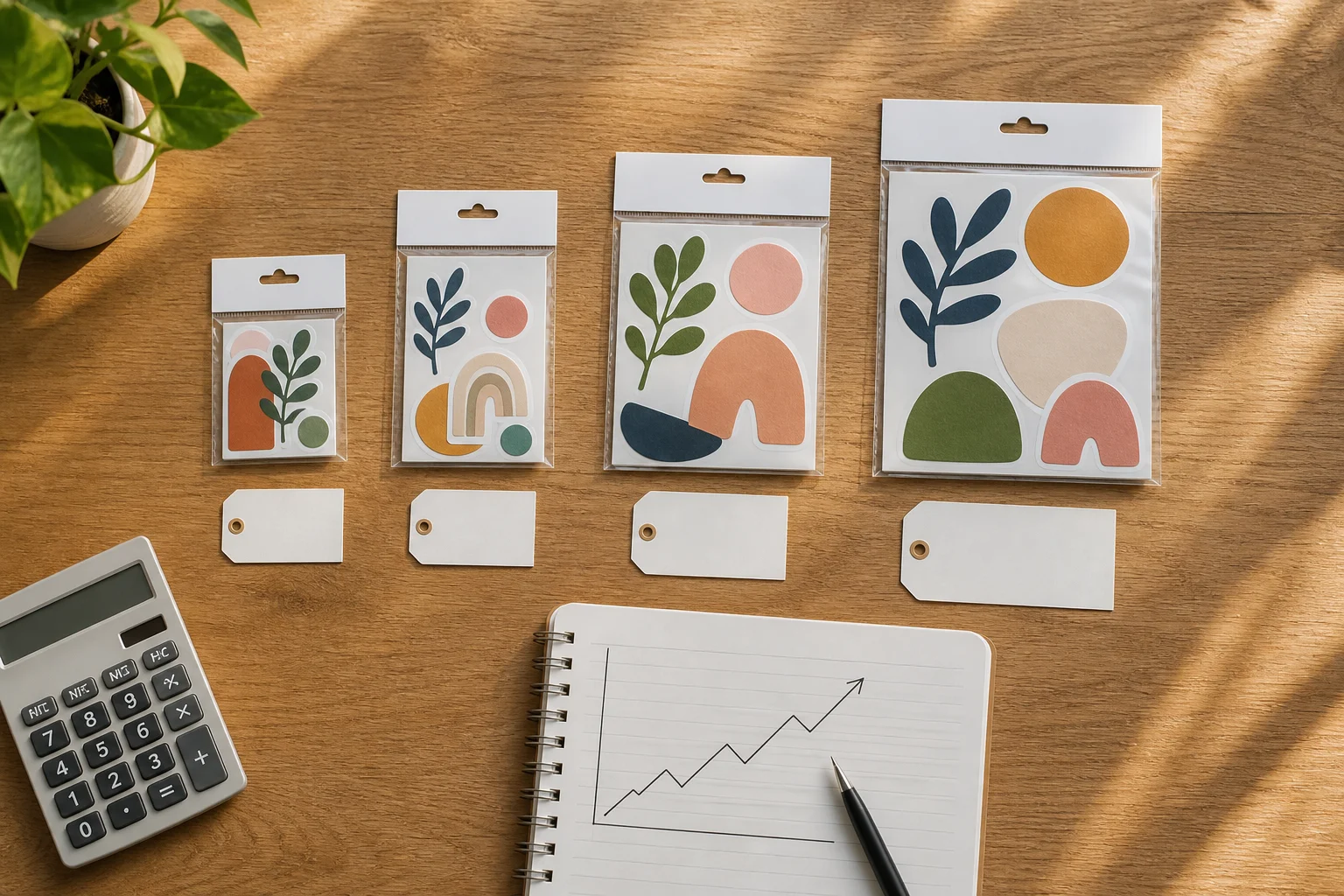
The single most common pricing error is pricing off the invoice price of the stickers. That's not your cost. Your cost is what you actually paid to get a finished pack sitting in your display:
| Cost component | What goes in |
|---|---|
| Product cost | Sticker packs as received from the supplier, per pack |
| Freight / shipping | Inbound shipping, customs, duties — allocated across packs |
| Packaging add-ons | Header cards, bags, or barcode labels if not included |
| Your handling | Time to receive, count, tag, and place the product |
| Shrink & damage | Budget 2–5% for packs that get damaged or lost |
Landed cost is the number you multiply. If you priced off product cost alone and your freight added 20%, your real margin is a fifth lower than you think. Full cost walkthrough: How to estimate sticker costs →
Want to test the math with real numbers? Send us your pack spec and target wholesale quantity — we'll quote per finished pack so you can calculate your landed cost before you commit. Get wholesale pack pricing →
Retail categories have conventional markup ranges. Stickers sit in the same family as greeting cards and small gift items — a "low-ticket impulse" category:
| Retail category type | Typical markup | Example |
|---|---|---|
| High-volume convenience goods | 1.5–2x | Candy, snacks, drinks |
| Impulse gift & novelty | 2–3x | Sticker packs, cards, keychains |
| Specialty & boutique items | 2.5–4x | Handmade goods, art prints |
| Apparel & accessories | 2.5–3.5x | Branded tees, tote bags |
So for a sticker pack that lands in your store at $1.40, the working retail range is $2.80 to $4.20. That's the framework — now the psychology narrows it.
Customers don't evaluate sticker packs with a calculator — they evaluate them against the change in their pocket. That means certain price points perform better than others, even when the margin is technically worse.
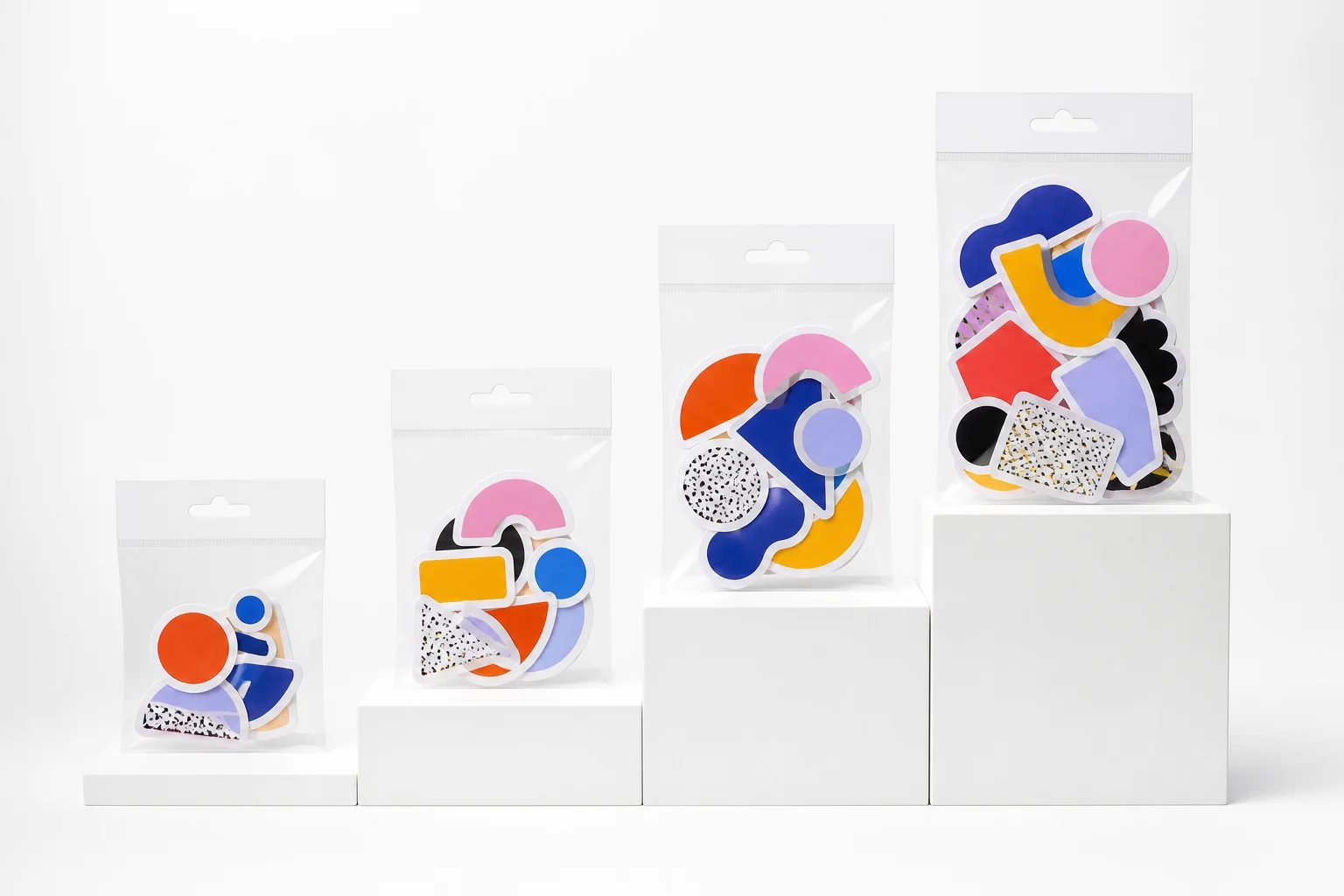
The highest-margin sticker displays don't sell one pack at one price. They sell three tiers, so every customer finds their own level:
| Tier | Pack contents | Landed cost | Retail price | Markup |
|---|---|---|---|---|
| Entry | Mini pack, 20–30 small stickers | $0.70 | $2.99 | 4.3x |
| Core | Standard pack, 8–15 die cut stickers | $1.40 | $4.99 | 3.6x |
| Premium | Large or holographic pack, 20+ stickers | $2.60 | $9.99 | 3.8x |
Three advantages of the ladder:
Format and sizing decisions behind each tier: Die cut vs kiss cut packs → and Mini pack strategy →
Building a three-tier line from scratch? We can quote entry, core, and premium packs together — same theme, three price points, one shipment. Quote a tiered line →
The markup framework is a starting point, not a law. Three situations where you should price differently:
Limited-edition or seasonal packs can carry a higher markup. If a customer knows the design won't be restocked, the price becomes less relevant than availability. This is how collectible sticker series sustain $8–12 price points.
An entry-tier pack at $1.99 can function as a loss leader — not to make money on that SKU, but to get customers to the register and near higher-margin items. Track whether basket size rises before committing to this long term.
"Buy 3, get 1 free" is common but usually the wrong lever for stickers. It trains customers to wait for the promotion and caps your margin. A cleaner alternative: bundle three packs at a fixed price slightly below the sum, using the bundle price to protect per-unit margin.

Run this every three months. It takes twenty minutes and catches most margin leaks:
Sticker packs fall in the impulse gift category, where 2–3x landed cost is standard. Entry-tier mini packs often support higher multiples (3.5–4.5x) because the absolute amount is small; premium tiers usually sit closer to 3x.
Add together the product cost per pack, allocated inbound freight and duties, any packaging add-ons, your handling time, and a 2–5% allowance for shrink and damage. Price off that total, not off the supplier invoice alone.
No. A three-tier ladder (entry, core, premium) converts better than a single price point. The entry tier starts the purchase, the premium tier makes the core tier look reasonable, and customers self-select by budget.
$2.99–3.50 for the checkout impulse tier, $4.99–5.50 for the gift tier, and $7.99–9.99 for a visible-quality premium tier. Avoid round numbers above $5, which read as considered purchases rather than impulse buys.
Wholesale is typically 50% of the suggested retail price, which gives the retailer the 2x minimum they need. If you're the retailer buying wholesale, your target is 2–3x the wholesale cost as your retail price.
Usually not as a first move. Slow sell-through is more often a placement or theme problem than a price problem. Discounting trains customers to wait for sales and permanently lowers your margin. Reposition, re-theme, or bundle first.
Mini packs typically retail at $2–4, with $2.99 being the strongest single price point. Above $4 the pack loses its impulse character and starts competing with standard-size packs. Mini pack guide →
Online prices often sit slightly below in-store prices because there's no impulse shelf and shipping is visible. Many retailers keep packs at the same price but add free-shipping thresholds to protect the in-store price point.
Good sticker pricing isn't about finding one perfect number — it's about building a ladder where the entry tier starts the purchase, the core tier earns your margin, and the premium tier makes the whole line look considered.
Jokeystickers has manufactured custom stickers for 24 years — retail-ready packs at every tier, with custom header cards and barcode printing, backed by international certifications (ISO, FSC, UL, and more). Free physical samples before production, and per-pack pricing you can build your retail math on.
Free samples · White-label ready · Barcode printing · DDP shipping
Send your theme and target quantities — we'll quote entry, core, and premium packs in one line.
Request Tiered Pack Pricing →Explore related products:


