
You've decided to stock sticker packs. Now comes the decision that quietly determines your sell-through: die cut or kiss cut?
Both formats sell — but they sell to different customers, at different price points, and at different rates. Buyers who understand the gap stock the right mix from day one. Buyers who don't end up with a shelf of packs that don't move.
This guide covers what each format is, how retail customers actually buy them, and how to split your order between the two.
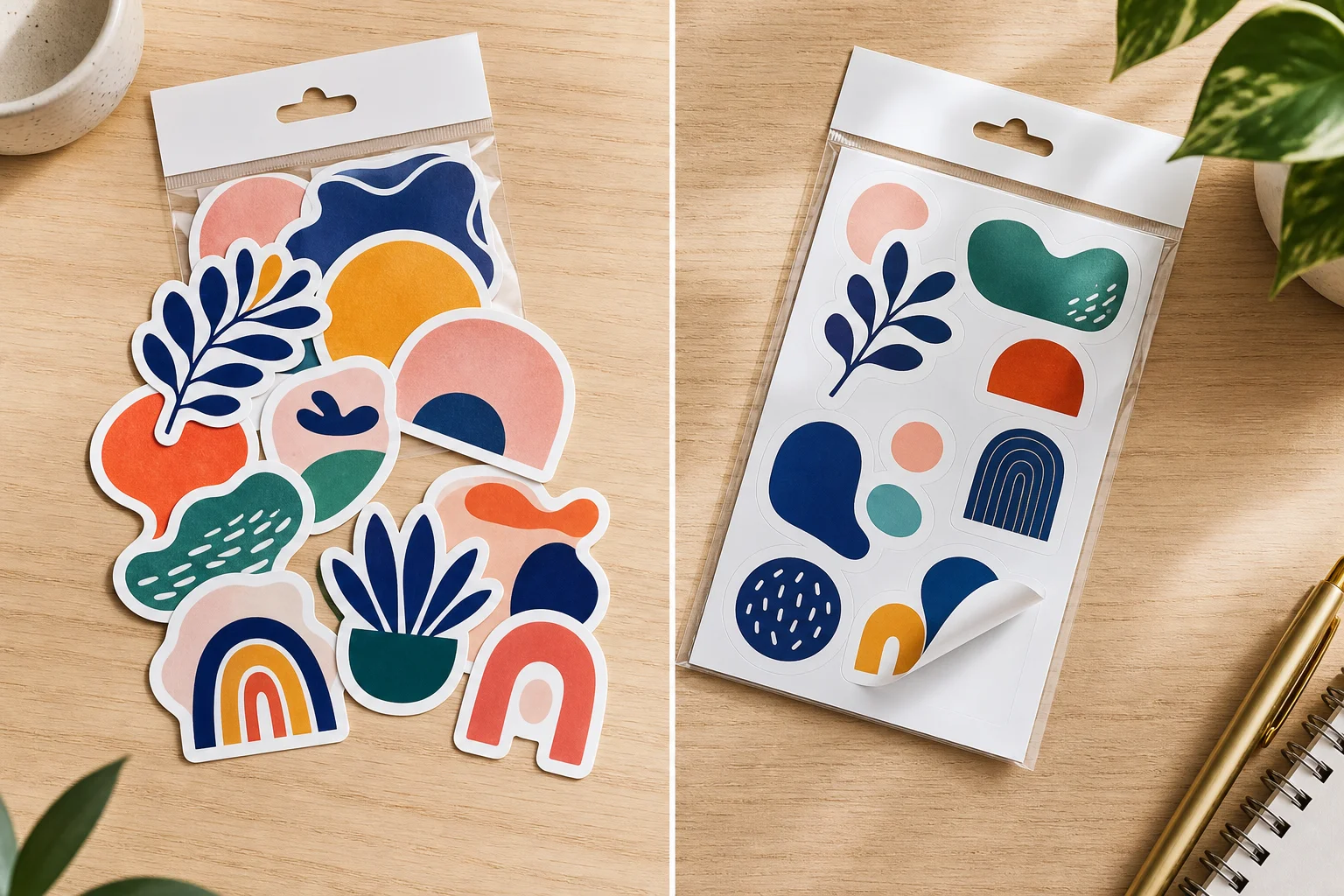
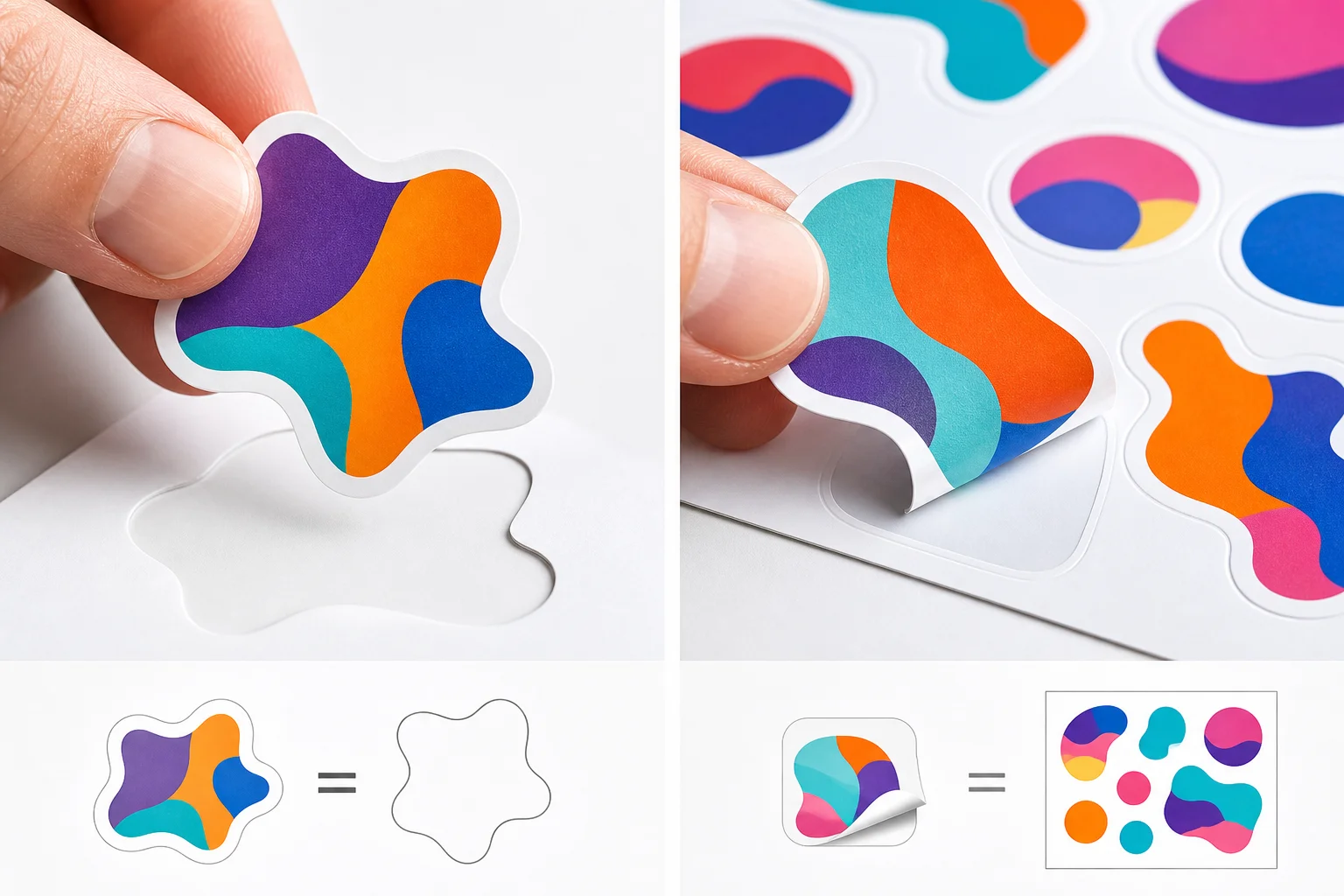
Die cut means the blade cuts through both the sticker material and the backing paper, leaving individual, fully separated stickers you can peel off one at a time. Kiss cut means the blade cuts only through the sticker material, not the backing — so several stickers stay on one shared backing sheet, like a page of stamps.
Packaging follows from that: die cut packs hold loose individual stickers; kiss cut packs hold printed sheets. Need the fuller breakdown? Full format comparison →
Not sure which cut to stock? Tell us your store type and customer base — we'll recommend the right die cut / kiss cut split and quote both formats. Get a format recommendation →
| Factor | Die Cut Packs | Kiss Cut Packs |
|---|---|---|
| What's in the pack | Loose individual shaped stickers | Printed sheets on shared backing |
| Perceived value | Premium — "real" stickers, individual shapes | High volume — "a whole sheet of stickers" |
| Cost per unit | Higher (individual cutting + handling) | Lower (single cut pass per sheet) |
| Typical retail price | $5–10 | $3–5 |
| Best for | Gift shops, boutiques, collectors, teens | Stationery stores, value shoppers, younger kids |
| Handling at checkout | Simple — loose stickers scan as one SKU | Simple — sheets scan as one SKU |
| Perceived count | Matches actual count | Feels like more (sheet format) |
| Display appeal | Strong — colorful shapes visible through bag | Strong — full sheet design visible |
Customer behavior is where the two formats really diverge. Based on how sticker products sell across retail channels, here's the honest pattern:
Die cut stickers are what customers buy for themselves as a treat or as a small gift. The individual shaped sticker — a cat, a mushroom, a slogan — has a personality that a sheet doesn't. This is why die cut dominates gift shops, boutiques, and stores serving teens and young adults.
Die cut also drives the collectible behavior: customers buy multiple packs to complete a set, and they come back for new releases. Die cut stickers →
A kiss cut sheet feels like more. Customers see a full sheet of dozens of designs and read it as exceptional value for $3–5. This makes kiss cut packs the volume leader in stationery stores and in stores with younger, budget-conscious shoppers — kids spending allowance money, parents buying a cheap treat.
Kiss cut is also the format that supports "use-case" buying: someone decorating a planner or journal wants a sheet they can work through over weeks, not individual stickers. Kiss cut stickers →
The same customer buys die cut when she wants a specific design, and kiss cut when she wants variety for a project. That's why the strongest sticker displays carry both — not as competitors, but as complementary tiers.
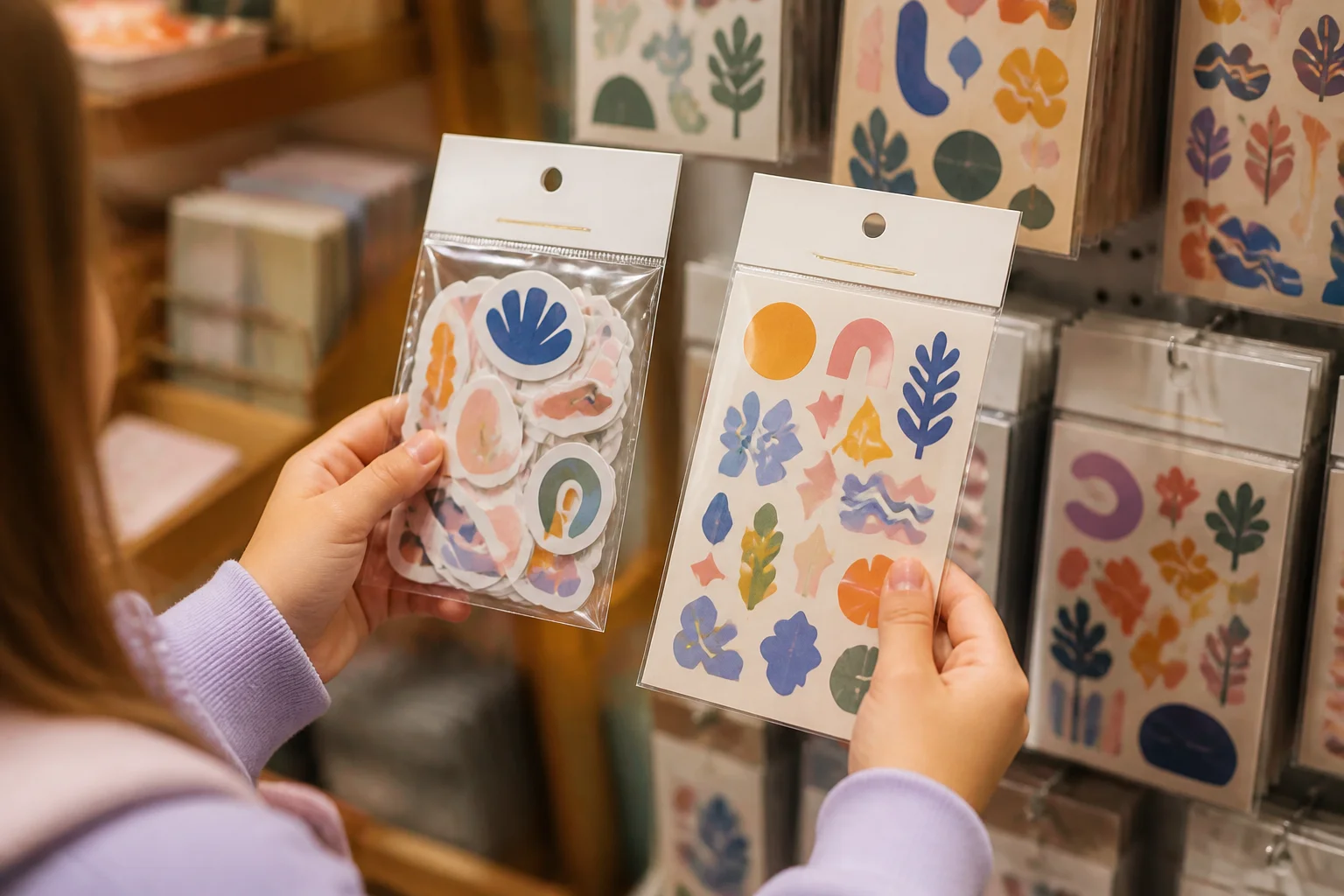
For most stores, a starting split looks like this:
Adjust based on your traffic. Some signals to read after 90 days:
Cost context for budgeting both tiers: Estimating sticker costs → and Pricing sticker packs →
Need both formats quoted together? Send your design line and target split — we'll quote die cut and kiss cut packs side by side, per finished retail-ready pack. Quote both formats →
Die cut packs contain individual stickers cut through both the sticker and the backing, so each peels off separately. Kiss cut packs contain sheets where the cut goes through the sticker material only, leaving multiple stickers on one shared backing sheet.
It depends on your customers. Die cut sells best in gift shops, boutiques, and stores serving teens and collectors. Kiss cut sells best in stationery stores and value-driven or younger-customer stores. Carrying both usually outperforms either alone.
Yes, typically. Die cut requires individual cutting and more handling, so the per-unit cost and retail price are both higher. Kiss cut costs less per pack and retails lower, at $3–5 versus $5–10.
Kiss cut usually wins on perceived value — a full sheet of designs reads as generous for the price. Die cut wins on perceived quality and individuality — the customer gets a specific shape they chose.
Yes, and you should. The two formats serve different buying moments. Mixing them lets customers self-select by budget and intent from a single display, which typically lifts overall sticker sales.
Start with a 60/40 split favoring die cut if you serve gift or teen customers, or 50/50 if you're unsure. Test for 90 days, track sell-through, and shift the split toward whichever format moves faster.
Yes. Mini die cut packs (loose tiny stickers) and mini kiss cut packs (small sheets) are both common, and both sell well at the checkout. Mini pack guide →
Die cut and kiss cut aren't competitors — they're two tiers of the same category, serving different customers and different moments. The retailers who win are the ones who stock both, price each to its tier, and let sell-through data decide the split.
Jokeystickers has manufactured custom stickers for 24 years — die cut, kiss cut, and retail-ready packs with custom header cards and barcode printing, all backed by international certifications (ISO, FSC, UL, and more). Free physical samples before production.
Free samples · White-label ready · Barcode printing · DDP shipping
Send your design line and target split — we'll quote both formats per finished pack.
Request a Dual-Format Quote →Explore related products:


